In any online discussion about tautological geographical names (such as River Avon, which means “river river”, the Sahara Desert, which means “desert desert” or Bredon Hill, which means “hill hill hill”), someone will always pop up to mention Torpenhow Hill in Cumbria, which combines the words tor, pen, how and hill to make “hill hill hill hill”.
The only problem with that is that Torpenhow Hill doesn’t really exist. Or rather, there’s no evidence to support the claim that the name evolved over time in the way that generally gives rise to tautologous names. It’s a modern invention, and only exists because it’s been deliberately contrived. Unlike, for example, River Avon and Bredon Hill, which both genuinely arose over time as a result of the evolution of language.
In fact, there isn’t anywhere in the UK which has any historical record of being called Torpenhow Hill. There are a couple of villages called Torpenhow, but no Torpenhow Hill.
“Ah!” someone will, at this point, exclaim, and point me to Google Maps. Which, to be sure, has a place called “Torpenhow Hill”.
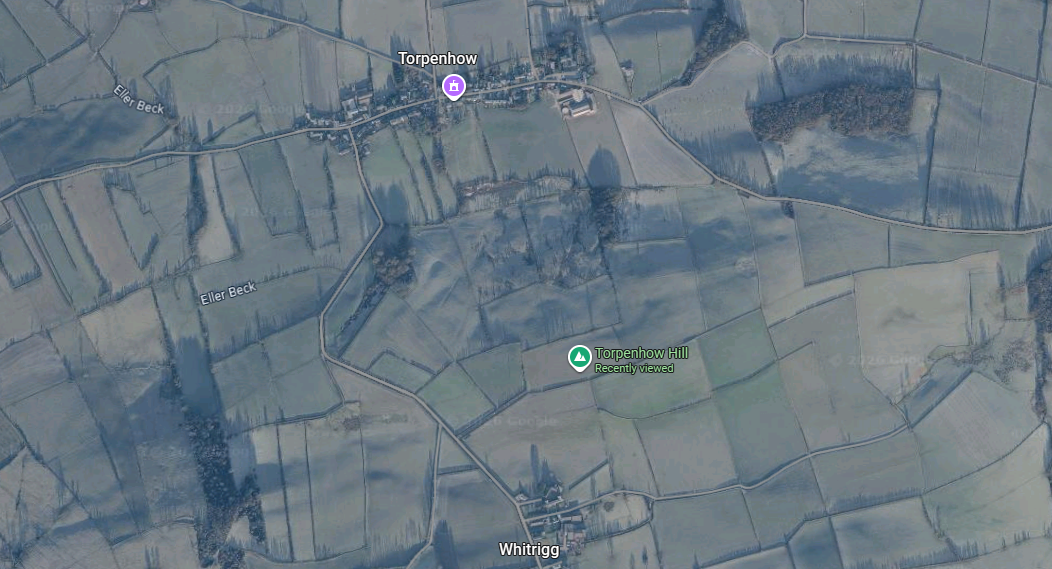
Torpenhow Hill on Google Maps
Unfortunately, that’s not particularly useful evidence, because Google Maps allows anyone to add names and edits to the map. And Google doesn’t apply any real quality control to user contributed data. I once got “Here be dragons” onto the map near where I live, and it stayed there until someone with possibly less sense of humour than me but almost certainly greater regard for accuracy renamed it to what it really is (a place on the River Avon – river river – where you can hire dragon pedalos).
If we want a more reliable map, we have to look elsewhere. Ordnance Survey is the official British mapping agency, and their maps and map data is pretty much canonical. And OS has no record of Torpenhow Hill. Here’s the same part of the country (note the villages of Torpenhow and Whitrigg at the top and bottom respectively) on an OS map.
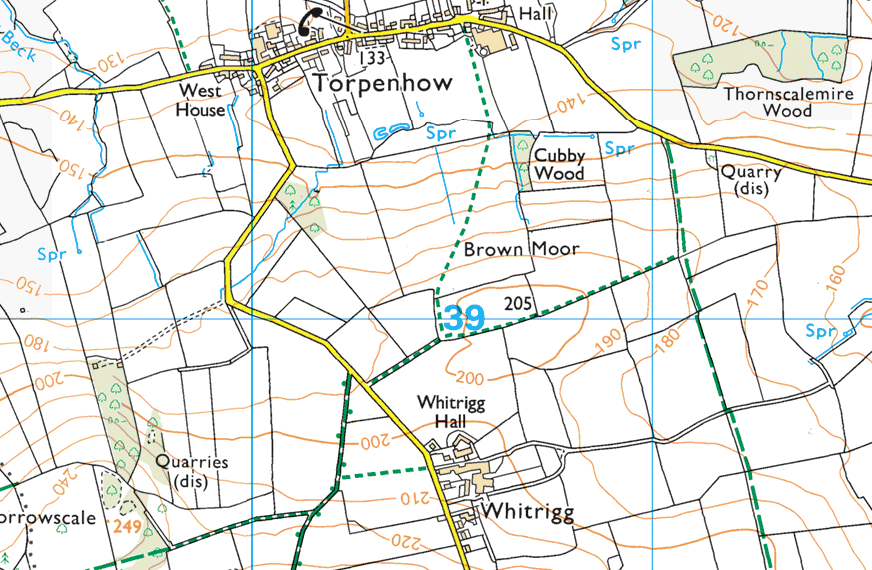
The area between Torpenhow and Whitrigg on OS maps
There’s also no entry for Torpenhow Hill in either Ordnance Survey OpenNames database, the Gazetteer of British Place Names, or the government’s Index of Place Names. It does appear in OpenStreetmap and Wikidata, but both of these are user-generated content (and the OSM entry relies on the Wikidata entry as its sole source).
Of course, if Torpenhow Hill did exist, there would be photos of it. And, indeed, on social media you will find photos of Torpenhow Hill. Except that they are not all photos of the same hill. This is a common one:
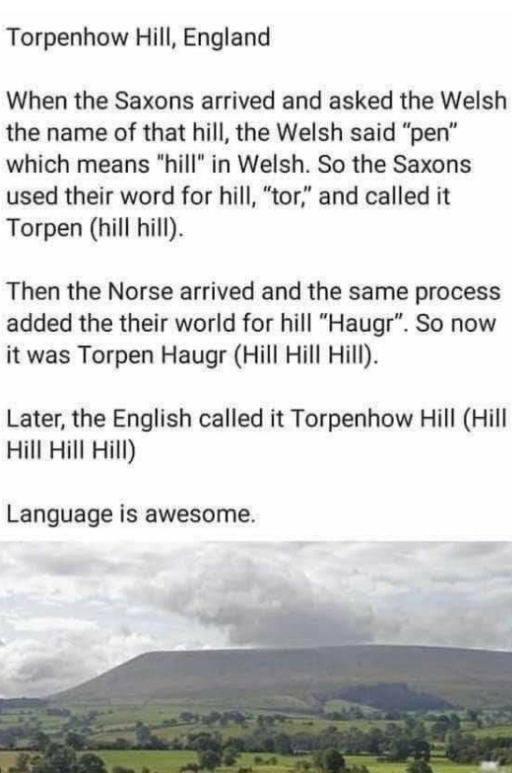
Not Torpenhow Hill
This is actually Pendle Hill.
Here’s another which has done the rounds of social media:
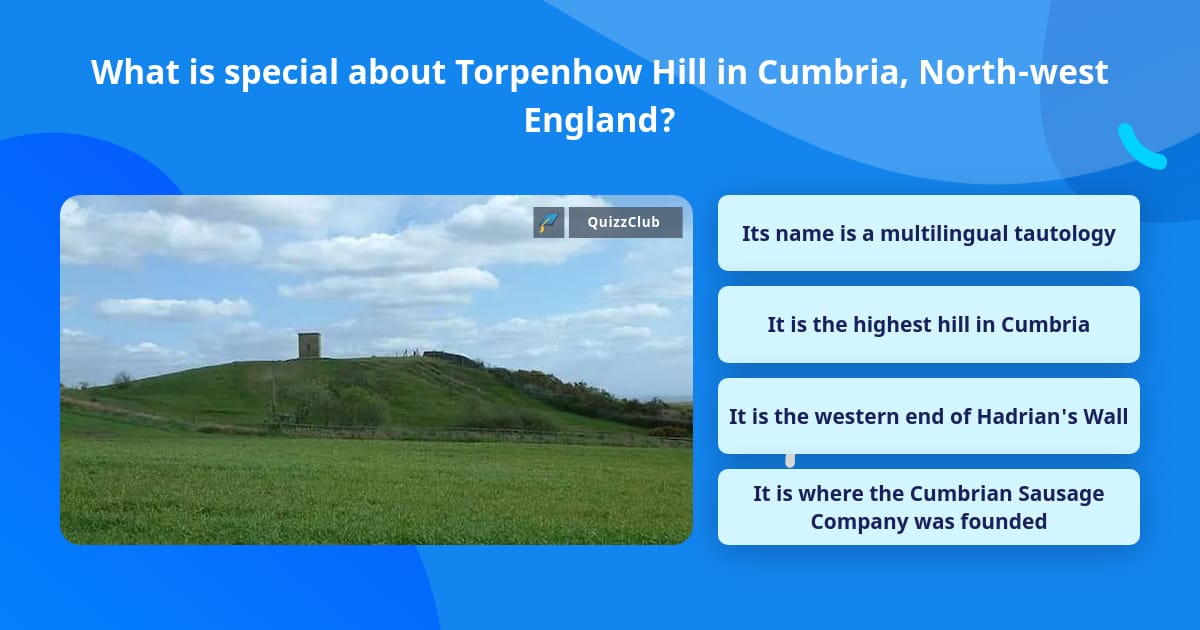
Not Torpenhow Hill
And this is actually Billinge Hill.
So maybe it’s this one:
Still not Torpenhow Hill
No, that’s High Wheeldon.
That’s the modern, readily accessible mapping evidence. But don’t take my word for it. The linguist Darryl Francis has done some extensive research, including checking various current and historical dictionaries of placenames. None of them mention Torpenhow Hill. I’m not going to quote all of his work here, but I will pull out a few relevant points.
The first is that the Oxford Dictionary of English Placenames has no entry for Torpenhow Hill. It does, though, have an entry for Torpenhow:
Torpenhow, Cumberland: The name contains the elements torr, ‘hill’, pen, ‘hill’ (Welsh pen), and Old English hoh, ‘ridge, spur of land’ or else (orr and Old Welsh pennou, the plural of pen, or torr and a name identical with Pinboe, Devonshire. In the first alternative the British name would have been Torr pen, to which was added Old English hoh. Torr pen would be analogous to Old Welsh tormeneth ‘top or breast of the hill’. The meaning would be about the same in the other alternatives.
So, while Torpenhow does have two words for hill in it (tor and pen), it’s still not really tautologous. The OEDP’s authors consider that the etymology is broadly equivalent to “top of the hill”, rather than “hill hill”. And, in particular, there’s no evidence for the assertion that the “how” in the name is from Scandinavian “haugr”.
Another relevant cite comes from The Placenames of Cumberland Part III, publish by Canbridge University Press in 1950:
Torpenhow Hall and church, which doubtless form the nucleus of the settlement, stand on a ‘rising topped hill ‘ which is itself on the northward slope of a long hill, and the name Torpenhow is doubtless descriptive of the site. The first element is the British torr, ‘ peak’, This would seem to have been compounded with British pen, Torpen then denoting ‘ peak-head’. To this was added in Anglian days the nglish hoh, giving forms Torpenho and the like. The old story, that the name bears witness to three successive races – British (Pen), Saxon (Tor), and Danish (How) – is incorrect: torr, though occasionally found in Old English, is really a loanword from British and torpen may well be pure British. The added how, to judge by earlier forms in -oc and -oh (ie Torpenoc, Torpenoh), would seem to be from English hoh rather than Old Norse haugr.
You can read the rest of Darryl Francis’s explanation of Torpenhow Hill here:
https://digitalcommons.butler.edu/cgi/viewcontent.cgi?article=4733&context=wordways
Or, in case that link to the original ever dies, I’ve put a copy here:
The Debunking of Torpenhow Hill
Nottingham University’s Key to English Place-Names concurs. In their records, the three elements of Torpenhow are
- torr [Old English] A rock, a rocky outcrop, a rocky peak
- penn [Primitive Welsh]
- hōh (hoh) [Old English] A heel; a sharply projecting piece of ground
This illustrates another issue with the assertion that Torpenhow (Hill) is a tautologous name. Genuinely tautologous names arise when newcomers to an area encounter a descriptive word in a different language to their own, and assume that it’s actually a name. So River Avon arose because speakers of more recent English didn’t realise that the ancient Brittonic word “avon” simply means “river”. And Bredon Hill follows the same pattern:
- brey – Brittonic for “hill”
- dūn – Old English for “hill”
- hill – Middle and later English for “hill”
These are sequential, chronologically. Brittonic was extent from around the 6th century BC to the 6th century AD, give or take. Old English arose in the 5th century, and Middle English evolved under the influence of Norman French from 1066 onwards. It’s entirely understandable that each of these words could be interpreted by a subsequent non-speaker of the language as a proper noun rather than a description.
Torpenhow, though, doesn’t follow the same pattern. If we assume that the ODEP and KEPN are right about the etymology (and there is absolutely no evidence to suggest otherwise), then the three elements are Old English, Primitive Welsh (or Old Welsh), and then Old English again. And these are not three successive linguistic eras. Old Welsh was a neighbour, not an antecedent, of Old English. The authors of The Placenames of Cumberland (quoted above) make exactly the same point.
So however the name Torpenhow arose, it wasn’t caused by people misunderstanding an archaic (to them) language. Cumbria, though not part of Wales, was part of the Celtic influenced milieu of pre-Norman Britain. Whoever first glued the words “tor”, “penn” and “hoh” together to make Torpenhow knew what all three of those words meant. It wasn’t a tautology then. And it still isn’t.