In the early days of the web, every self-respecting website had a “links” page which listed other sites that the reader may find interesting. The phrase “surfing the web” came from the practice of starting with a website you already knew, then following the links page to discover new sites, and then following their links to other sites, and so on.
Links pages gradually lost their role in website discovery with the creation of directories, such as DMOZ and the original Yahoo, and then the rise in search engines such as AltaVista and Google. For a while in the early 21st century, social media networks such as MySpace, Twitter and the early Facebook were also key sources of website discovery.
It wasn’t long, though, before the social media networks started to make it harder to use them to discover websites. Monetisation means maximising user retention, and every click to an off-network website reduces their opportunity to put more adverts in front of eyeballs. So posts containing links are downgraded by the algorithms, and fewer people see them.
More recently, though, even the search engines have started to turn their backs on website discovery. The AI overviews at the top of most result pages pushes website links down the page and makes it much less likely that people will see them.
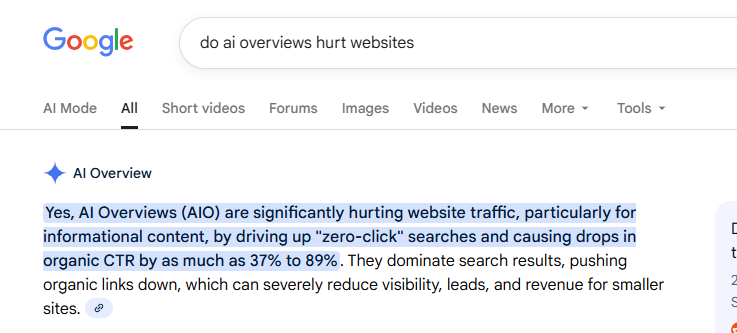
This is reducing visits to websites, as even Gooogle’s own AI agrees. In some cases, this may be no great loss. But it is a major blow to sites which rely on advertising to survive. And it also means that even official, authoritative sources of key information (such as the government, or your local council) are being downgraded in favour of unreliable AI summaries. People will accept an AI summary as gospel rather than checking the source, or looking to see what the media have to say.
So, with the loss of discovery traffic from social media, and now the loss of search engine traffic, how will independent websites survive?
A lot of them won’t, of course. But in the long run, I have a feeling we’re going to see the independent web going back to its roots. Websites linking to each other. Maybe even the return of webrings! And possibly the reinvention of web search by new entrants into the market. The web ecosystem and the social media/AI ecosystems will diverge. And maybe, just maybe, in the long run the web will be better for it.